Concealer placement: under-eye, blemish, and everywhere else
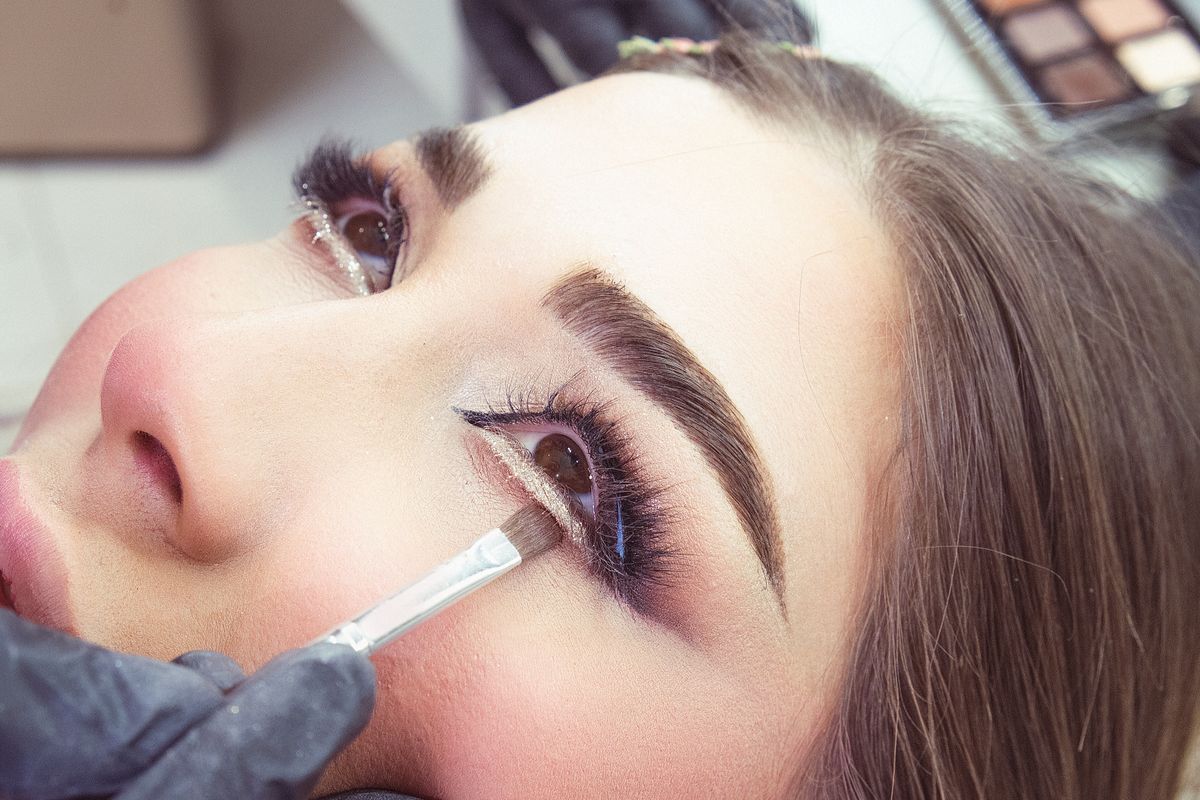
Concealer is not one product doing one job. Placed under the eyes it brightens; on a blemish it must disappear; along the nose or mouth it cleans edges. Each zone has its own shade logic and its own failure mode, and running one method everywhere is why concealer ends up creased, gray, or obvious.
Under-eyes: the triangle
The dark circle is not a circle — it is a shadow that runs from the inner corner down and out toward the cheek. Placement follows that geometry: three short strokes forming a triangle, along the lower lash line, down toward the cheek, and back toward the outer corner, then pressed — not dragged — with a finger or sponge.
Shade logic here is brighten: one to two shades lighter than the base, leaning peach or salmon to counter the blue-violet cast most under-eye shadows carry. On deeper skin tones the corrector matters more than the lightener — an orange-red corrector under a matched concealer covers what a light shade alone cannot.
The texture trap: under-eye skin is thin and lined for most adults, and thick concealer creases into every one of those lines within the hour. The fix is subtraction — the thinnest film that covers, a hydrating formula rather than a matte one, and a whisper of powder only where the triangle actually creases. A heavy layer cannot be rescued by setting; it was too much before the powder arrived.
Blemishes: match exactly
A spot that needs hiding needs invisibility, and a lighter shade advertises it. Match the base exactly — the same foundation shade matching method applies here as to full-face base — and place concealer only on the blemish itself, pressed on with a small brush or fingertip, edges feathered until the border dissolves. Setting powder keeps it through the day; concealer over an unprepped, raised blemish slides off by lunch, which is a surface question the primer guide explains.

Correctors: only when color shows through
A color corrector goes under concealer and exists to cancel one hue with another: green against red, peach and orange against blue-violet shadow, yellow against mild purple on lighter skin. The rule is necessity — correct only when the discoloration is strong enough to show through a normal layer of concealer. Correcting everything doubles the layer count in exactly the zones that crease first, and layering order matters more there than anywhere else on the face.
Everywhere else
The same product earns its keep at the outer corners of the nose where redness and glasses collect, at the mouth corners, in the inner eye where shadow pools, and as an edge-cleaner around a lip or brow line. Shade logic reverts to exact match for all of it — brightening belongs under the eyes and nowhere else. The honest limit: concealer reduces a shadow and covers pigment; it does not erase texture or fill a line. Placement decides whether anyone is looking at the line in the first place.
Frequently asked
- Should concealer be lighter than foundation?
- Only under the eyes, where the job is brightening — one to two shades lighter, leaning peach. Blemishes and edge clean-up need an exact match, because a lighter shade there draws attention to the very spot it is hiding.
- Do green color correctors actually work?
- Yes, mechanically — green sits opposite red on the color wheel, so a thin layer mutes redness that would otherwise show through concealer. Use it only where the red is strong enough to need it; everywhere else it just adds a layer that can crease.
- Why does my under-eye concealer crease no matter what?
- Usually amount, not formula. Under-eye skin is thin and lined, and a thick film settles into every line once it moves. A thinner layer pressed in rather than painted, with powder only where creasing actually happens, is the fix that holds.