Eyeshadow for hooded eyes: the map that actually works

On a hooded eye, the fold of skin from the brow bone drapes over part or all of the mobile lid, so the space most eyeshadow tutorials are written for barely exists once the eyes open. That is the whole problem and the whole solution: placement done with closed eyes disappears, so the map has to be drawn with the eyes open.
What the hood changes
With eyes open, the visible lid is not the surface you see in the mirror with eyes closed — it is a narrower band between the lash line and the hood’s edge, sometimes only a few millimeters. Standard placement puts a crease shade “in the crease,” but on a hooded eye that crease sits under the drape, so the shadow lands there and vanishes. Worse, the fold presses against the lid with every blink, so anything placed in the fold zone transfers upward and smudges within the hour.
Mapping above the crease
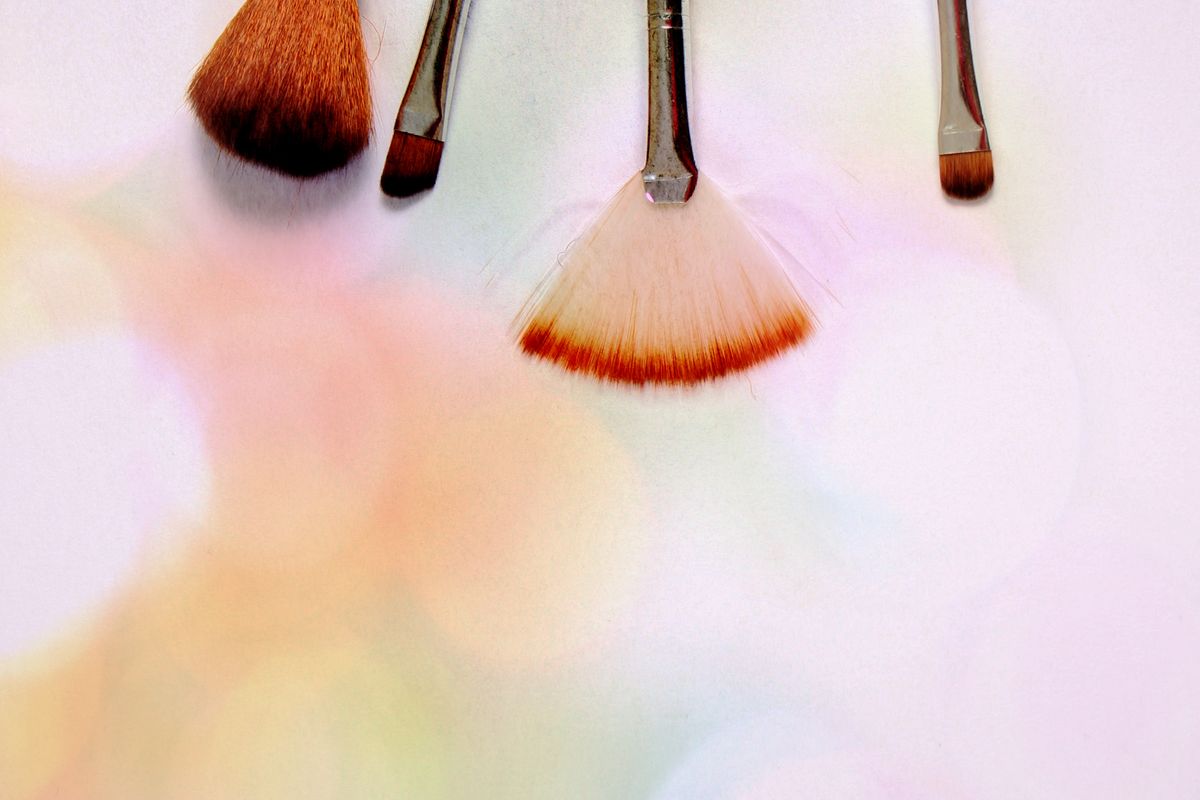
The working rule: place color where you want it visible with eyes open, which is usually above the crease, not in it. Find the position by looking straight ahead and locating the hood’s edge; the transition shade goes slightly above that line, diffused upward with a small blending brush — one fluffy brush from a minimal brush set does the whole job. Deeper tones stay low, tight against the lash line, where they read as depth instead of getting swallowed. The gradient structure does the lifting: lightest near the inner corner and above the fold, deepest at the lash line. Keep the fold line itself clean, because pigment there transfers and muddies fast.
Practically, this means the classic closed-eye sequence fails on hoods. Check every step with eyes open, and expect the placement to look high and slightly strange with eyes closed — that is the sign it is right, not wrong.
Transfer-aware placement
Blinking is the enemy. The fold drags across the lid thousands of times a day, so the fold zone — not the lash line — is where smudging starts. A thin base or primer under the shadow, set with a whisper of powder, buys adhesion the bare lid cannot hold; the surface-prep logic is the same one the primer guide covers for the rest of the face. Shimmer is not off-limits, but it belongs above the fold or pressed tight at the lash line. A large shimmer panel across the mobile lid reads as a smeared stripe by afternoon, because the fold has been polishing it all day.
Tightlining buys back definition
Pigment pressed into the upper waterline and the roots of the lashes defines the eye without spending any visible lid space, which makes it the highest-value technique for hoods. A lash-line pencil or dark shadow worked into the roots does what liner drawn on the lid cannot: it survives the fold, because the fold never reaches it. Mascara finishes the frame, and formula choice matters more here than almost anywhere — a heavy, slow-setting formula transfers onto the hood before it dries, which the mascara formulas comparison sorts by setting speed and flexibility.
No map removes the hood. What the map does is spend color only where it will still be visible at six in the evening, which is the difference between eyeshadow that shows up and eyeshadow you applied and lost.
Frequently asked
- Can hooded eyes wear shimmer?
- Yes, placed above the fold or tight at the lash line. A wide shimmer panel across the mobile lid transfers and smears with blinking, because the fold polishes that surface all day.
- What is the difference between hooded eyes and monolids?
- A monolid has no visible crease at all; a hooded eye has a crease that the brow-bone fold partially or fully covers when the eyes are open. The mapping-above-the-fold approach serves both, though monolids usually have more uninterrupted space to work with.
- How do I stop eyeshadow transferring into my crease?
- Keep pigment out of the fold line, prime and set the lid so shadow holds, and check placement with eyes open. Transfer comes from the fold pressing against product; no setting trick fixes product placed where the fold lands.